

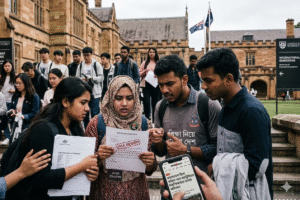
Bangladeshi students in Australia 2026 has become a much tougher journey than before. For years, Australia has been one of the top choices for Bangladeshi students dreaming of a world‑class education and better career opportunities. But as of January 2026, things have changed dramatically. The Australian government has tightened visa rules, moving Bangladesh into the high‑risk Evidence Level 3 category. This means stricter checks, longer waiting times, and more documents to prove financial and academic credibility.
What looked like a golden opportunity in late 2025 has now turned into a tough challenge. Let’s break down what’s happening, why it matters, and what Bangladeshi students can do next.
The Rollercoaster: From 2025 Boom to 2026 Crisis
Late 2025: Bangladesh was briefly upgraded to Evidence Level 1. Visa approvals shot up to nearly 95%, and students rushed to apply.
January 2026: Within weeks, the government reversed course. Bangladesh, along with India, Nepal, and Bhutan, was downgraded to Level 3 (high‑risk). Suddenly, the same students who were celebrating easy approvals now face stricter scrutiny and higher rejection rates.
This sudden shift has left many families confused and worried about their children’s future.
Key 2026 Changes Affecting Bangladeshi Students in Australia
Risk Level Update: Bangladesh is now Level 3 under the Simplified Student Visa Framework (SSVF).
Stricter Scrutiny: Students must show detailed financial documents and academic records. Manual verification is common.
Age Limit: Maximum age for student visas is now 35 years.
English Requirement: Minimum IELTS score of 6.5 overall, with at least 5.5 in each band.
Processing Times: Applications take longer, with more chances of delay.
Work Rights: Students can still work 48 hours per fortnight during study terms and full‑time during breaks.
Why Did Australia Tighten the Rules?
According to the Australian Department of Home Affairs , Bangladeshi students in Australia 2026 must now meet stricter financial and English requirements. The government says the changes are about integrity and trust. Officials pointed to:
A rise in fraudulent financial and academic documents from South Asia.
Growing anti‑immigration sentiment in Australia.
Unusual spikes in applications — for example, Nepal’s student numbers even surpassed China’s in 2022.
In short, Australia wants to filter out non‑genuine applicants, but genuine students are feeling the pressure too.
Challenges for Bangladeshi Students in Australia 2026
Financial Burden: Students must prove they can cover tuition plus living costs (over AUD 24,000 per year).
Higher Rejection Rates: Even small mistakes in documents can lead to rejection.
Mental Stress: Many students feel unfairly targeted and discouraged.
Changing Plans: Families are now considering Canada, Germany, and New Zealand as alternatives.
Real Voices from Students and Experts
Immigration Lawyer Mohammad Nizamuddin: “Frequent policy changes are making the future uncertain for talented students.”
Student Fahim Hossain (pseudonym): “We spend hundreds of thousands of taka to study here. But the current environment makes it seem as though international students are the root of all problems.”
Student Sultana Akter (pseudonym): “Rules should be transparent. Discouraging talented students is not the right approach.”
These voices show the frustration and uncertainty spreading among Bangladeshi students in Australia.
The Bigger Picture: Australia’s Education Sector in Trouble
Australia’s international education industry is worth USD 54 billion. But experts warn that negative immigration messaging and strict visa rules could damage this sector. Already, visa slow‑processing has led to a 15% drop in new student numbers. If the trend continues, universities may lose revenue and Australia could lose its edge in the global education market.
Opportunities Still Exist for Bangladeshi Students in Australia 2026
Despite the challenges, Australia is not completely closed off:
Top Universities: Institutions like the University of Melbourne, ANU, and UNSW remain globally ranked.
Post‑Study Work Rights: Graduates can still gain 2–4 years of work experience through the Temporary Graduate Visa.
Regional Options: Studying outside Sydney or Melbourne can reduce living costs.
Scholarships: Competitive scholarships are available, though harder to secure.
Practical Advice for Bangladeshi Students in Australia 2026
Plan Finances Early: Make sure your financial documents are genuine and clear.
Boost English Skills: Aim for IELTS 7.0+ to stand out.
Choose Reputable Universities: Applications to well‑ranked institutions carry more weight.
Avoid Fraudulent Agents: Work only with trusted consultants.
Explore Alternatives: Compare Australia with Canada, Germany, and New Zealand.
Stay Updated: Keep track of official announcements, as rules change quickly.
Alternatives to Australia
Canada: Strong migration pathways and a welcoming Bangladeshi community.
Germany: Low tuition fees and excellent scholarship opportunities.
New Zealand: Easier visa process and affordable education.
Europe (Netherlands, Sweden): English‑taught programs with moderate costs.
The 2026 visa tightening has created a tough environment for Bangladeshi students in Australia 2026. While the country still offers world‑class education and career opportunities, the barriers are higher than ever. Students must prepare thoroughly, stay transparent with documents, and consider alternative destinations if needed.
For Australia, the challenge is clear: balance integrity with openness. If the government fails to send a positive message, the multi‑billion‑dollar education sector could face long‑term damage — and talented students from Bangladesh may look elsewhere for their future.
📩 Call to Action
Ready to find your perfect country for study abroad from Bangladesh ? 👉 [Talk to our expert about your academic goals]